More Homes, Sooner. But Where Will They Go?
BCC’s latest planning scheme amendments are a positive step, but will incremental change be enough to meet Brisbane’s housing challenge?
Brisbane City Council (BCC) is planning for an additional 210,000 dwellings by 2046. At an average of 2.5 persons per household, that equates to more than 500,000 additional people calling Brisbane home over the next two decades.
At the same time, Greater Brisbane’s population continues to grow rapidly, driven by strong interstate migration and overseas arrivals. The scale and immediacy of Brisbane’s housing challenge is becoming increasingly difficult to ignore.
Earlier this year, Council released the proposed More Homes Sooner amendment package, aimed at promoting low to medium density infill development in targeted locations. Council has now also publicly notified its Tailored Amendment Package for the Indooroopilly, Carindale and Nundah Major Centres, which remains on public notice until 25 May 2026.
Both amendment packages represent positive steps in the right direction. Our concern is that both amendments are not bold enough, and modest planning changes alone may not be enough to meaningfully shift housing supply outcomes. The broader question remains whether Brisbane’s current planning settings can realistically deliver the housing the city needs.
History is a Great Predictor of the Future
Infinitum Partners has been closely involved in drafting planning schemes, planning scheme amendments, Priority Development Area (PDA) development schemes, and development incentive strategies across Queensland. One consistent lesson emerges from this experience: planning policy alone does not deliver housing supply.
Commercial realities, including construction costs, land assembly, infrastructure capacity, interest rates and market demand, ultimately determine development feasibility.
This can be seen across multiple Queensland jurisdictions. Highly aspirational planning frameworks introduced over the past decade have often resulted in fewer redevelopment outcomes than initially anticipated, despite supportive zoning, increased height limits and more flexible assessment pathways.
This is not necessarily a failure of planning policy. Rather, it is a reminder that development follows the path of greatest feasibility, of which town planning is only one aspect.
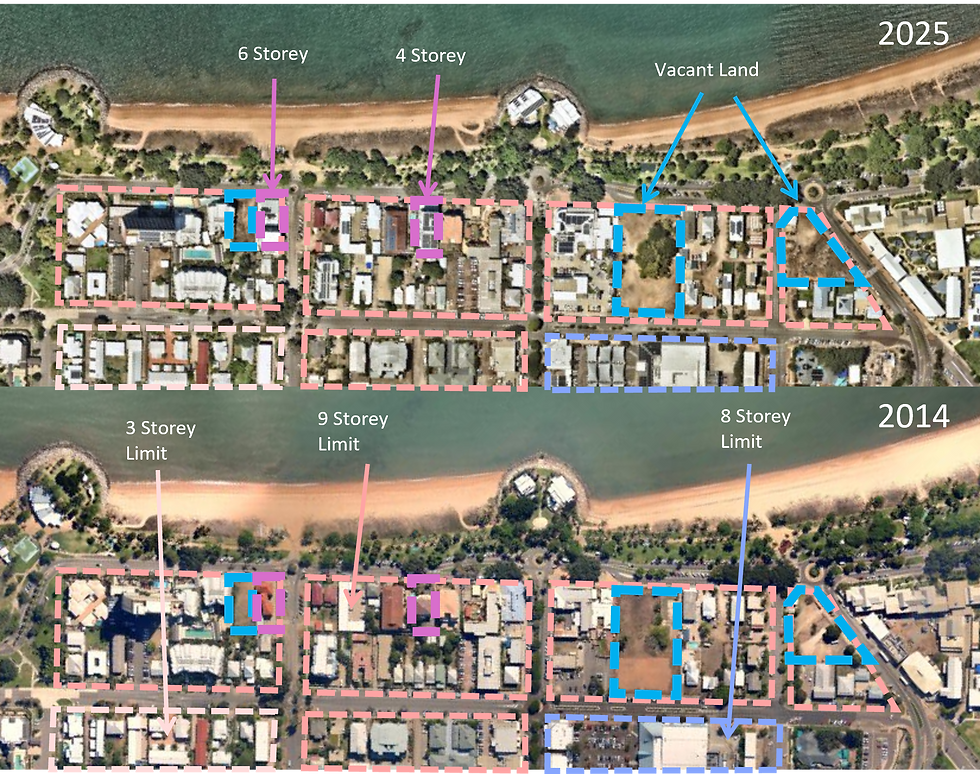
The 2014 Townsville City Council Planning Scheme and accompanying Waterfront PDA were highly aspirational planning instruments. More than a decade later, in premier locations like the Strand foreshore, many sites remain undeveloped despite supportive planning settings.
Interestingly, the prescribed nine-storey height limit along the Strand is nearly double what has ultimately been delivered on the two projects completed in this section of the Strand. What this demonstrates is that height was not the determining factor for development feasibility in these instances.
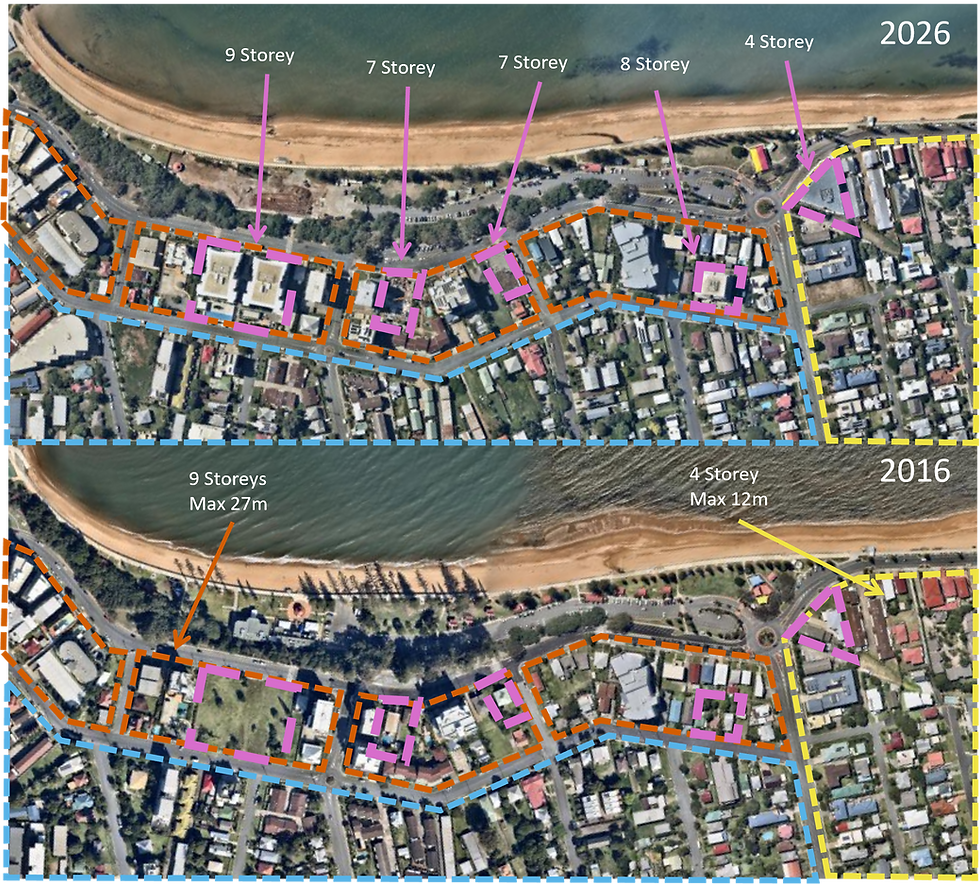
A similar pattern can be observed across parts of the Redcliffe foreshore, where increased height limits and supportive planning provisions have not necessarily translated into redevelopment outcomes at the scale originally anticipated.
Alternatively, greenfield development areas continue to outperform many infill markets because sites are generally easier to assemble, land is often vacant, and detached housing remains comparatively simple and affordable to deliver.
Brisbane, however, does not have the same greenfield land supply available to surrounding local government areas. In seeking to limit urban sprawl and reduce long daily commutes, Council has instead pursued a “go up rather than out” approach to growth. The challenge is that increasing allowable height does not automatically create viable development outcomes.
Are Current Planning Settings Enough?
The proposed Major Centres amendment package:
does not materially expand the footprint of land capable of accommodating medium to high density housing;
primarily focuses on height increases within existing centres;
includes sites that may be commercially difficult to redevelop, for example in the airspace above two of South East Queensland’s largest shopping centres; and
captures areas that have already recently developed or are unlikely to redevelop in the short to medium term.
This raises a broader strategic question: are Brisbane’s current planning settings going far enough to realistically accommodate another 210,000 dwellings?
Brisbane is now Australia’s largest local government area and one of the country’s fastest growing cities. Major public infrastructure investments including Brisbane Metro and Cross River Rail are reshaping how the city functions and where future growth should occur.
Yet much of the surrounding urban fabric remains protected by long-standing low-density zoning patterns that significantly constrain housing supply.
Without a broader, scheme-led approach to rezoning and housing diversity, other mechanisms such as Priority Development Areas increasingly step in to facilitate outcomes that conventional planning frameworks struggle to deliver. This is a failure of planning policy and can be addressed without the need for State intervention.
Incrementally increasing building heights within select centres may improve development potential at the margins, but height alone does not guarantee supply. The larger issue remains where Brisbane’s future housing supply will realistically be delivered, and if we continue to do the same thing again will we ever slow or put downward pressure on housing affordability.
Planning policy optimisation, such as increasing height limits, will not, on its own, support development feasibility. Experience across Queensland demonstrates that redevelopment often occurs more slowly and sporadically than planning policy initially anticipates, and planned yields are optimistic relative to actual development outcomes.
This is why Brisbane’s remaining Low Density residential areas, and the broader More Homes Sooner amendment package needs to carry a larger share of future housing growth. Traditional building character, flood and environmental constraints should always inform development potential, however anywhere else not affected by these types of matters should be available for low to medium density infill development.
Housing Diversity May be the More Immediate Solution
History suggests that more substantial interventions across the housing typology spectrum are often needed to meaningfully unlock supply within established urban areas.
At present, housing typologies that can be relatively simply integrated into existing suburbs, often only two to three storeys in scale, may represent the most viable and immediately deliverable supply solution available to Brisbane.
While major urban renewal precincts will continue to play an important role in delivering medium to high density housing, these sites also come with their own complexities, including fragmented ownership, infrastructure upgrades and lengthy delivery timeframes.
The historic Toombul shopping centre site is one example where vacant land availability and development scale may ultimately provide a more feasible redevelopment outcome than some of the constrained sites currently identified within existing Nundah Major Centres.
Simpler and more diverse housing forms, delivered across a broader number of smaller sites, may ultimately provide a more realistic pathway to increasing supply in the short to medium term.
Our View
Incremental change is still progress, and each amendment acknowledges the important role planning policy can play in improving housing outcomes.
However, history consistently demonstrates that modest interventions rarely deliver transformational supply outcomes at the scale ultimately required.
If Brisbane is serious about accommodating future growth, more ambitious interventions may be necessary, including broader rezoning, reconsideration of traditional low-density areas, greater flexibility around lot sizes, and stronger support for diverse housing forms across established suburbs.
The city has invested heavily in transport and infrastructure that should support a more compact urban form. The challenge now is whether planning policy is prepared to fully leverage that investment.
Without broader structural change, there is a genuine question around where Brisbane’s future housing supply will realistically be delivered.


